How to choose pants: fit, fabric and what's worth paying for
A good pair of pants can change the proportions of everything you wear with them. Understand fit, rise, fabric and price, then find the pants that match what you actually want.
The rise affects where your shirt ends. The width through the thigh changes how the leg falls. The hem opening determines how the pants meet your shoes. And two pairs labelled “relaxed fit” can look completely different once you compare their actual measurements.
Buying online makes this harder. Waist size alone tells you very little about silhouette, and familiar labels like slim, straight or wide are not standardized between brands.
This guide explains what to look for. Start with the silhouette you want, understand the measurements that create it, choose a fabric that behaves the way you want, and then decide which construction and finishing details are worth paying for.
Disco's own category research, published product data and owner discussions, read together. Where we haven't tested something, we say so.
Start with how you'll wear them
Before comparing brands, decide what role the pants need to play.
Everyday pants
A straight or relaxed shape in a fabric that works across several outfits. Pay attention to the rise, thigh and leg opening rather than focusing only on waist size.
Cleaner, smarter outfits
A relatively clean line through the leg, and a fabric with enough structure or drape to hold that silhouette. Check how the pants sit at the waist and whether excess fabric collects around the shoe.
A wider silhouette
Generous room through the thigh and a wider hem opening. Sizing up a regular pair is not the same thing: you may gain waist room and length without the proportions you wanted.
A tapered silhouette
Room where you need it through the seat and thigh, then a meaningful reduction toward the ankle. The hem opening matters as much as the word “tapered.”
Warm-weather pants
Fabric and cut both matter. A light fabric can still feel restrictive cut close to the body, and more room through the leg can improve how pants feel even when the cloth is not exceptionally light.
These are starting points, not rules. The goal is to identify the combination of shape, fabric and length that produces the look and feel you want.
Choose your silhouette
Fit names describe a brand's intention. Measurements describe the pants. The same word can mean two different patterns at two brands, and sometimes at the same brand across models.
It also helps to separate what the names describe. Slim, straight and relaxed mainly describe room. Tapered and wide describe the shape of the leg below the seat. Cropped tells you specifically about length. A cropped pair can also be slim, straight or wide.
The outlines below are drawn to one scale and aligned at the waistband, so the thigh, the leg opening and the length all move where the pattern moves them.
Straight
Relatively consistent width from the thigh toward the hem. “Straight” still ranges from fairly narrow to very generous, so check the measurements.
Schematic outlines, one scale, aligned at the waistband. Not garment measurements.
Why pants have been getting wider
Pant proportions move in cycles. The useful part isn't knowing which silhouette is currently fashionable. It's understanding where the extra width goes.
As trousers become fuller, brands may increase the rise, add room through the seat and thigh, reduce the taper and widen the hem. That's why wide pants aren't simply slim pants in a larger size.
The visible trend is width. The useful information is where that width was added. Schematic outlines, not garment measurements.
The measurements that create the silhouette
Six numbers do almost all of the work. Waist tells you whether the pants will fasten. The other five tell you what they will look like.
Waist is useful but not enough. Two pairs with the same waist measurement can look completely different because of their rise, seat and leg proportions. Confirm what the chart is describing, too: garment measurement, body measurement, laid-flat width and circumference are not interchangeable.
Rise is the distance between the crotch area and the waistband. In practice it influences where the pants sit on your body and how long the upper portion of the trouser appears. A higher rise places the waistband higher and changes the relationship between your torso and legs; a lower rise places it farther down. Rather than treating one as more flattering, decide where you want the pants to sit and compare the actual figures.
Thigh is the most overlooked measurement when buying online. It affects comfort while sitting and walking, how much fabric hangs below the hip, whether a pair looks genuinely relaxed, and how aggressively the leg can taper. If pants consistently feel tight even when the waist is correct, thigh room may be the issue.
Knee helps you understand the shape between the thigh and the hem, and can distinguish a genuinely straight leg from one that starts narrowing early. Very few brands publish it, and none of the charts on this page do, so treat it as something to look for rather than something to compare.
Leg opening is one of the most useful silhouette measurements of all: a smaller opening finishes narrowly around the ankle, a larger one produces a straighter or wider line and changes how the pants fall over sneakers or boots.
Inseam tells you length, but not the whole way the pants will wear. Rise affects where they begin; inseam affects where they end. Two pairs with the same inseam can therefore sit very differently.
Waist tells you whether the pants may fasten. Rise, thigh and leg opening tell you much more about how they'll look.
Rise
Where the pants sit, and how long the top of the trouser reads.
Thigh
Comfort when sitting, and how much fabric hangs below the hip.
Leg opening
Whether the leg finishes narrow, straight or wide over the shoe.
Waist, knee and inseam still matter. They just describe less of the silhouette.
Same waist. Very different pants.
Both of these are sold as a relaxed fit, and they measure the same at the waist, to a tenth of an inch. Everything else is different. Pair B's waistband sits three inches higher, it carries more room through the thigh, and it finishes an inch and a half wider at the hem. One is labelled 33 and the other 30.
Photographs are the brands' own product shots, aligned for comparison and not to scale. A brand shoots one sample, so the picture is not the size named. The measurements below are from each brand's published chart, at that size.
There is no single correct amount of room. Instead, check whether the fit looks intentional for the silhouette you chose. At the waist, the pants should stay where you intend to wear them without an extreme amount of belt tension. Around the seat and thigh, look at whether the fabric is pulling in a way you do not want, or collapsing into excess folds.
Then look below the knee. Does the leg remain straight, taper, or widen? Where does the hem meet the shoe? Does the fabric break once, repeatedly stack, or finish above it? The answer depends on the style you are trying to achieve.
A wide leg is not “too large” simply because there is more fabric than a slim trouser. A short hem is not incorrect if the pants are deliberately cropped.
How to measure pants you already own
Your easiest reference point is usually a pair you already like. Lay them flat without stretching the waistband unless the brand specifically instructs otherwise.
Waist. Fasten the pants and align the waistband, then measure according to the retailer's method. Some brands measure straight across; others give full circumference or a body-waist recommendation.
Rise. Follow the same start and end points used by the brand you are comparing against, because conventions differ.
Thigh. Check exactly where the brand takes this measurement. Directly below the crotch will not match one taken farther down the leg.
Leg opening. Lay the hem flat and measure across it. This is the easiest useful measurement to compare consistently.
Inseam. Measure from the crotch seam down the inside leg to the hem.
Compare the pattern, not one number. Rise, thigh, knee, opening and inseam together tell you far more about what will arrive than a matching waist.
Inches, measured flat. Thigh and leg opening are single-layer flat measurements, and brands take the thigh at different points on the leg, so check the diagram on the product page before comparing.
Fabric does more than change how pants feel. It affects how they hang, crease, move, stretch and hold their shape. The important question is not whether a fabric sounds premium, but whether its behaviour suits the silhouette you chose.
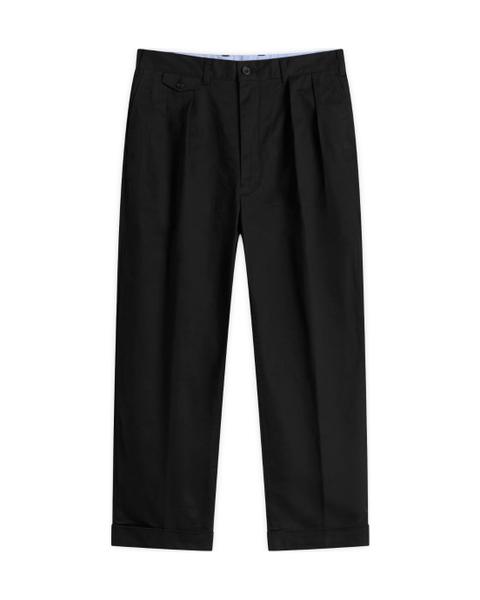
Cotton twill is common in chinos and workwear-style pants. Depending on weight, yarn and finishing it ranges from relatively crisp to soft and broken-in. A firmer twill gives straight or wider trousers more visible structure; softer versions fall closer to the body.
Beams Plus 2 Pleat Chino
Denim deserves its own guide, but the buying questions are the same: weight, stiffness, stretch, wash, rise, thigh and taper. Raw rigid denim and heavily washed stretch denim share a word and deliver very different experiences.
Benzak B-01
Wool ranges from structured tailoring cloth to soft, fluid fabrics. Fibre alone does not tell you how formal a pair will appear. Look at the weave, weight, finishing and cut.
Rick Owens Dietrich
Linen feels cool and creases visibly and quickly. That relaxed surface is part of why many people like it. Blends alter the texture, crease behaviour and structure.
Corduroy adds surface texture and usually more visual weight than a smooth cotton. The width of the wale, the raised cord, changes the character considerably.
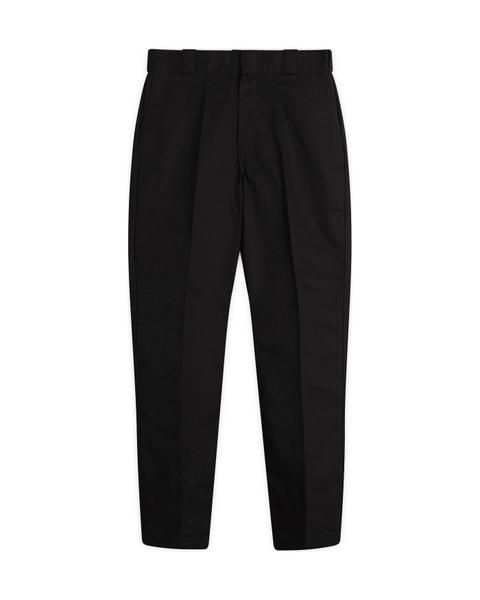
Synthetic and performance blends use nylon, polyester or elastane to add stretch, faster drying or abrasion resistance. Do not judge a pair by the presence or absence of synthetic fibres; look at what the material is supposed to accomplish.
Dickies 874, a poly-cotton twill
Pictured where Disco's pants list includes a pair cut in that cloth. Linen and corduroy have none we can point at, so they are described but not shown.
Structure versus drape
For T-shirts, fabric weight in GSM is the number worth learning, and we explain it in the T-shirt guide. For pants it is less useful: brands publish trouser weights inconsistently, and two similarly weighted fabrics can behave differently depending on construction.
The more useful idea is a spectrum. At one end, crisp and structured fabrics hold a defined shape, keep volume visible and let the cut read clearly. At the other, soft and fluid fabrics hang and move more freely and follow the body differently.
Crisp / structured
Holds a defined shape. More visible volume. Useful when you want the cut to read clearly.
Soft / fluid
Hangs and moves more freely. Follows the body differently as you walk.
Firm cotton twillChino and workwear weightsHolds a defined leg; volume stays visible.
Washed or softened twillBroken-in finishKeeps some structure, falls closer to the body.
Fluid wool or cellulosic blendTailoring and warm-weather clothsFollows movement; a wide leg reads much softer.
Positions on this line are Disco's read of how a cloth behaves, not a measurement. There is no published number for drape the way there is for weight.
Wide does not describe one look. A stiff wide trouser and a fluid wide trouser can share measurements and read completely differently.
Stretch versus cut
Stretch can improve mobility, but cut can provide mobility too, and more stretch is not automatically better. A small amount of elastane may make a closer-fitting pair easier to move in. A rigid fabric can preserve a particular shape or develop differently through wear.
For each product, read the complete composition rather than relying on terms such as “comfort stretch.” And remember that cut provides mobility too: a generously cut rigid trouser may feel less restrictive than a narrow stretch one.
Price drivers · from cloth to shelf
Why do these pants cost more?
Price can rise at several stages, from the cloth itself to the pattern, finishing, manufacturing and eventually how the product is sold. None of those automatically makes better pants.
Read down: the order a pair of pants is actually made in. Read across: what standard production might use, and the decisions that can add cost at that stage.
StageWhat standard production might useWhere cost can enter →
01
Fibre & fabric“100% cotton” can describe an enormous range of fabrics.
Pattern & constructionSome of the most valuable differences are invisible: pattern development can matter more than an obvious “premium” detail.
Standardised pattern and straightforward construction.
More developed proportions, pleating, complex waistband or pocket work.More sewing operations.rise · pleats · waistband · pockets · internal finishing
05
Trims & componentsBetter hardware can add cost. It cannot fix the wrong silhouette.
Reliable mass-produced components.
Custom or higher-spec hardware and trims.zipper · buttons · adjusters · pocketing
06
Production & scaleLarge runs spread development and setup costs across more garments.
Larger production runs.
Smaller runs, higher labour cost.More handling and operations.setup · labour · volume · handling · QC
After the garment leaves the factory
07
Retail & brandNot every extra dollar is inside the pants.
Direct selling, lower overhead.
Wholesale and retail margin, stores, marketing, customer acquisition, positioning.wholesale · stores · marketing · positioningNot every extra dollar is inside the pants.
More expensive does not mean better on every dimension. It usually means more money entered somewhere in the cloth, the making, the selling, or the brand.
What doesn't automatically make pants better?
Heavier fabricMore material and structure, not automatically a better fabric.
SelvedgeAn interesting production characteristic, not a universal quality score.
More construction detailsComplexity matters only when the result matters.
Expensive hardwareOne component of the trouser.
Made in a particular countryCan affect labour cost and production context; geography alone isn't quality.
So where do the differences actually appear between real pants at $29.99, $158, $208 and $524? Compare 4 real pairs ↓
Disco comparison
What are you actually paying for in expensive pants?
The ledger above explains where money can enter. This is where we test it: the same fields across 4 pairs, and for each one our read of what you appear to be paying for. We are not trying to prove the expensive pair deserves its price, only to say where the differences appear to be.
Select a column to read our interpretation of it.
Swipe to compare →
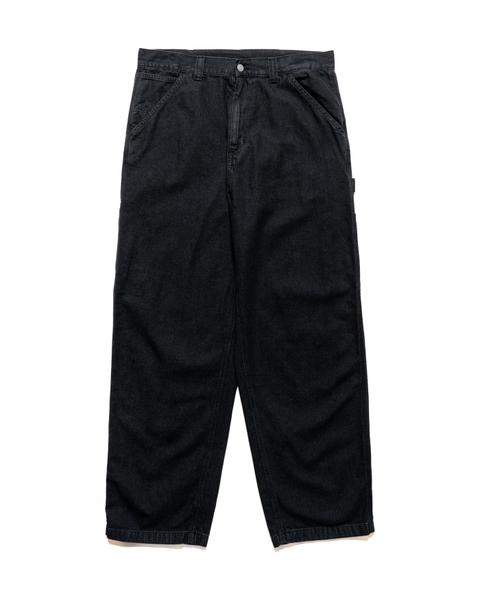
Price$29.99$158$208$524Fabric65% polyester / 35% cotton, 8.5 oz twill100% organic cotton “Dearborn” canvas, 12 oz100% cotton, 13 oz Japanese selvedge denim100% cotton, 14 oz right-hand twill selvedge denimFabric source / millNot named. The spec says only “imported fabric”.Cloth named, mill not statedWoven by Kurabo, JapanWoven on a Toyoda Shuttle Loom G3RiseNot published13.6″ at a 3210.6″ at a 3210.0″ at a 34ThighNot published14.2″ at a 3212.7″ at a 3213.0″ at a 34OpeningNot published8.7″ at a 327.1″ at a 327.0″ at a 34FinishingColour and stain-release treatment; resists wrinklesNot statedUnwashed (raw), sanforizedAishita, the Kyoto black montsuki over-dye: black layered on indigo, repeatedlyConstructionReinforced seams, welt back pockets, tunnel belt loopsRelaxed straight, mid rise. Triple-stitched seams, bartacks at stress points, tool pockets and a hammer loop.Curved two-piece waistband, cotton-poly pocket bags, core-spun heavy-duty stitching, bartacks and buttonholes.Relaxed tapered. Front rise 10–10.5″ and back rise 14–15″ by size; plain back pockets on the overseas version.HardwareNot statedZip fly. Button and rivets not stated.Stainless steel buttons, copper rivets, button fly. Italian vegetable-tanned leather patch.Not statedManufacturingImported. Country not named.Not statedMade in PortugalMade in JapanWhat you're paying forScale, mostly. A shape that works, at the lowest cost here, with almost nothing about it documented.A named cloth and a documented pattern. The making is conventional and the factory is not named.Everything on record. The mill, the finish, the hardware and the factory country are all named, and the block is graded in odd waists.Cloth and process. A shuttle loom and a repeated hand-dye are slow; the construction is not more complex than the pair at $208.
Disco's read
Carhartt WIP Single Knee Pant
Worth paying more if… you want the roomiest thigh here in a canvas that is named and dated, and a size run wide enough to find your waist.
Probably unnecessary if… you want the cloth's origin or the factory on record, because neither is published.
Specs and price read from Carhartt WIP Single Knee Pant product page, September 21, 2026. Prices change; check before buying.
Where the money shows up on the garment
These are things to investigate on the product page and after the pants arrive, not quality badges. Pleats are not a quality feature, and one stitching method does not automatically make a pair better.
Check the closure type, the internal construction and whether there are adjustment features.
Look at placement, depth, and how bulky they become when you actually carry something.
These tell you how the pants are intended to be worn and adjusted, and whether a belt is assumed.
Pleats add fabric in the upper portion of the trouser. They change volume and drape; they are not a quality feature.
Construction matters most where stress repeats: the seat, the crotch and the pocket openings. Avoid reducing quality to a checklist.
Check whether the pants arrive finished, unfinished or cuffed, and whether there is enough allowance for tailoring.
Price can buy different fabric, construction and proportions. It does not automatically buy the best pants for you.
Differences at the top of the range need to be documented for the actual product rather than assumed from the price. A distinctive fabric or an unusual silhouette can be worth it to one buyer and irrelevant to another.
Our advice: buy one unfamiliar model first when you can. Check the fit before removing tags, then judge how the fabric behaves after a wash before committing to a second pair.
Alterations change the equation
Some trouser dimensions are easier to change than others. When choosing between two sizes or two pairs, prioritise the ones that are hardest to fix.
Often simpler
Hem length. Some waist adjustment, depending on construction and seam allowance.
More involved
Taper through the lower leg. Adjustments through the seat.
Hard to change
Rise, thigh and the underlying pattern.
Buy the silhouette first. Alter the simpler dimensions second. We would have a tailor review any detailed alteration guidance before relying on it.
Keeping the fit you bought
Follow the care label. Washing, drying and pressing can affect dimensions, finish and drape depending on the fabric. For a pair you particularly like, record the waist, inseam, thigh and opening when new, then measure again after laundering using the same method. That gives you product-specific information instead of a generic shrinkage assumption. For wool, tailored garments or anything labelled dry-clean only, follow the manufacturer's instructions rather than treating them like ordinary cotton chinos.
A few places to start. These examples help explain the choices in this guide; the full selection, filters and live prices live on Best Pants.
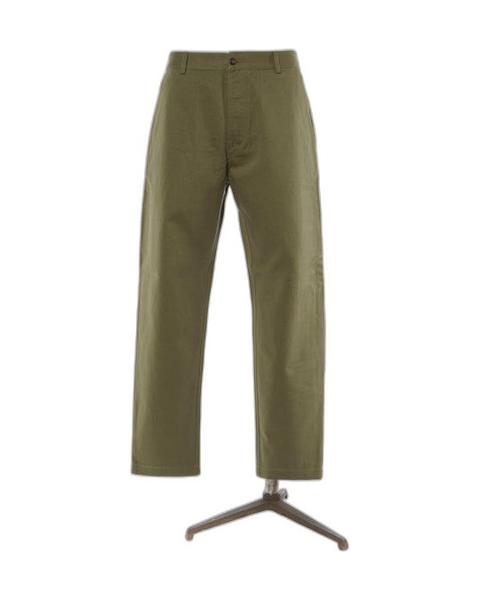
Best overallCarhartt WIPSingle Knee PantRelaxed · Mid rise · 12 oz cotton canvasHeavy canvas in a genuinely relaxed cut, graded across thirteen waists — the widest measured size run here.Best chinoUniversal WorksMilitary ChinoStraight · Mid rise · Cotton twillFuller than a mall chino and cleaner than a work pant — the middle almost nobody actually cuts.Studio D'ArtisanD1864 Relax TaperedRelaxed · Mid rise · 13.5 oz Kyoto black-dyed selvedgeThe chart behind this guide's own comparison: more room through the thigh than the jean beside it, and a full inch narrower at the hem.Best valueDickies874 Original Fit Work PantStraight · Mid rise · 8.5 oz poly-cotton twillNothing else here costs $30 and holds a crease. Straight and unremarkable, which is the whole point.
Brands worth knowing
What each brand contributes to the category: proportion, fabric or construction, rather than a company biography.
There is no universal answer, but a straight or moderately relaxed cut is an easy starting point because it does not depend on an extreme taper or width. The more useful approach is to compare it with pants you already wear frequently.
What is the difference between straight and relaxed pants?
“Straight” usually describes the shape of the leg; “relaxed” usually describes additional room, particularly higher in the trouser. A pair can be both. Check the thigh, knee and leg-opening measurements rather than treating the labels as mutually exclusive.
What does high rise mean?
It describes a longer rise, and usually means the waistband is designed to sit higher. There is no universal measurement at which every pair becomes “high rise,” so compare the exact product with pants you already own.
Should I size up for baggy pants?
Usually start with a pair patterned to be baggy or wide rather than sizing up. Sizing up changes the waist and other dimensions along with the leg. Compare measurements first.
How long should pants be?
That depends on the silhouette and the footwear. Some pants are intended to finish cleanly above the shoe; others have a slight break; others deliberately stack. Decide which effect you want, and evaluate inseam alongside rise.
Are wider pants more comfortable?
They may provide more room, but comfort depends on the whole pattern, the fabric and how the waistband and seat fit you. A wide lower leg does not guarantee adequate room in the thigh or seat.
Are expensive pants more durable?
Price alone cannot establish durability. Look at the actual fabric, construction, intended use and credible long-term evidence for the specific model.
How we researched this guide
3,100+
Brands curated by Disco
59,012
Comments across 200 owner threads
11
Published pants size charts on file
Brand pages
Specs read at the source, and dated
We combine Disco's category research with published measurements, fabric composition, construction details, retailer and brand information, and owner experience. Product examples illustrate the choices described above rather than serving as results from independent laboratory testing. Where Disco has not personally tested a product or claim, we say so. Prices are dated snapshots. Owner discussion was gathered September 3, 2026. Disco may earn a commission from qualifying purchases through some links.