
Patchwork Tailoring
Deconstructed blazers, shirts and jeans spliced from clashing panels are the clearest expression of Watanabe's cut-and-rebuild philosophy.
6 live now · from $337
Explore patchwork → disco
discoBrand profile
Tokyo label under the Comme des Garcons umbrella, known for technical fabrics, patchwork, deconstructed tailoring and heavy workwear collaborations.
29 brands like Junya Watanabe like Comme des Garçons, Sacai, UNDERCOVER →
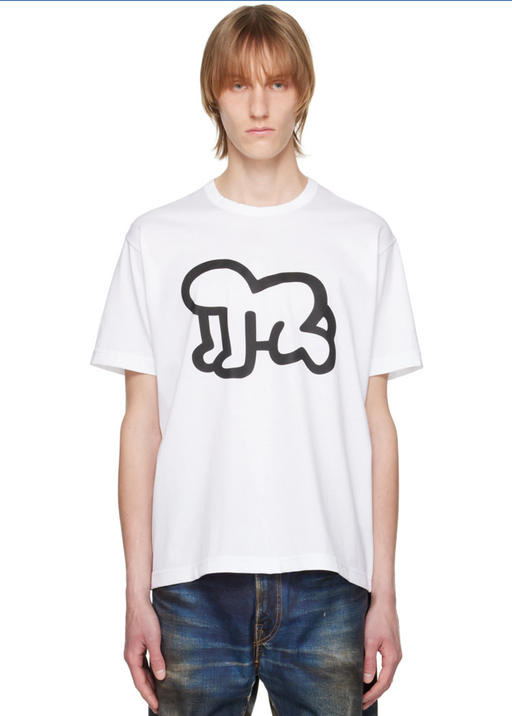


Collections are built on pattern-cutting experiments: engineered pleating, patchwork and deconstructed tailoring, often in technical fabrics rather than conventional suiting cloth.
Watanabe joined CDG as a pattern cutter in 1984 and led Tricot from 1987; since 1992 his own label has been produced from Tokyo and shown in Paris under the CDG umbrella.
Junya Watanabe MAN reworks workwear, military and denim with partners including The North Face, Carhartt, New Balance and Canada Goose, at designer rather than workwear pricing.
Deconstructed blazers, shirts and jeans spliced from clashing panels are the clearest expression of Watanabe's cut-and-rebuild philosophy.
6 live now · from $337
Explore patchwork →
His long-running Carhartt collaborations turned utilitarian chore and work jackets into the label's most recognizable menswear statement.
1 live now · from $1,013
Explore Carhartt jackets →
The multi-pocket work blazer — tailoring built on workwear bones — is the hybrid garment Watanabe keeps returning to each season.
3 live now · from $904
Explore work blazers →Available atDeeCee style · Rooney
Overall fit
runs small
Sized on a Japanese scale, Junya Watanabe MAN typically wears about one size smaller than comparable Western labels, so a US medium usually lands in a large, with the caveat that certain conceptual or collaboration pieces are cut intentionally voluminous.
Tip: Most shoppers size up one from their usual US/EU size, but check the specific piece since deconstructed or workwear-derived items can already be cut oversized.
Medium confidence · based on 14 sources
By category
| Category | Runs | Shape | Size advice |
|---|---|---|---|
| Hoodies & sweatshirts | slightly small | regular to slightly boxy depending on collaboration | Take one size up if you plan to layer underneath. |
| Shirts & overshirts | runs small | trim through the shoulders and armhole, with narrow sleeves | Size up one, especially if you have a broader chest or longer arms. |
| Trousers & pants | runs small | slim to regular with a clean, tailored line | Expect to go up a size in the waist and to check the inseam before committing. |
| Jeans & denim | runs small | slim, straight or tapered on most Levi's-era collaborations | Size up in the waist; the tagged size typically measures smaller than a standard US denim size. |
| Jackets | mixed | tailored blazers and shirt jackets run narrow, while patchwork, military and technical outerwear collaborations can be notably roomy | Judge each jacket individually: size up for tailored pieces, consider your usual size for the oversized outerwear. |
| T-shirts & graphic tees | runs small | slim to regular, close through the chest and sleeve | Size up one from your usual tee size unless you want a very trim fit. |
Directional fit consensus summarized from public sources with AI — a starting point, not a guarantee. Confirm with the product's own measurements before buying.
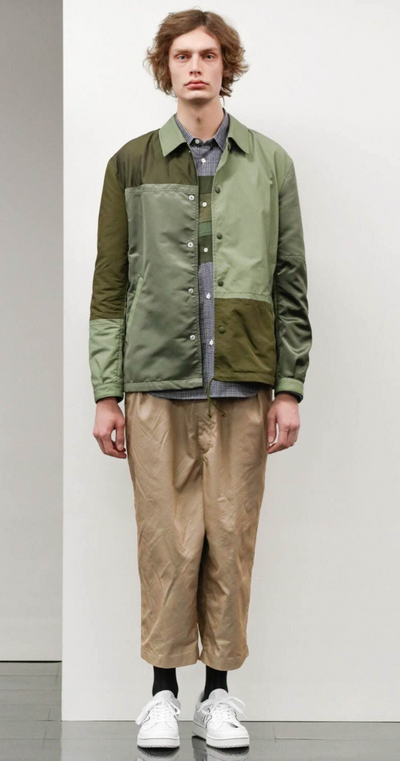 92% match
The parent house: same pattern-cutting radicalism
What changes: More conceptual womenswear-led, less workwear/denim reworking
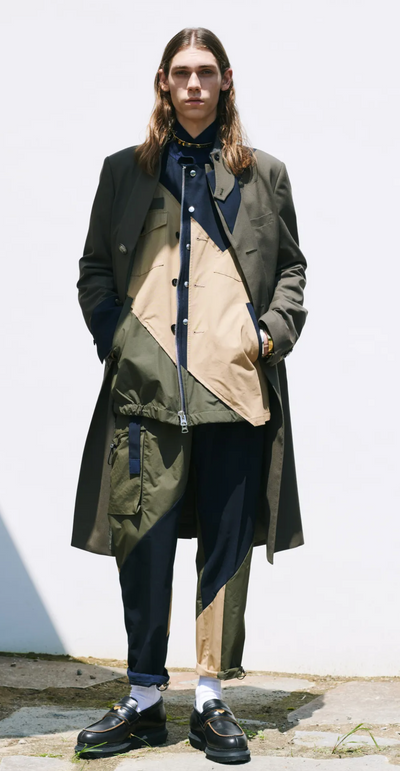 88% match
Hybrid splicing of archetypes, same Tokyo hybrid logic
What changes: Softer, more commercial layering; fewer heritage-workwear collabs
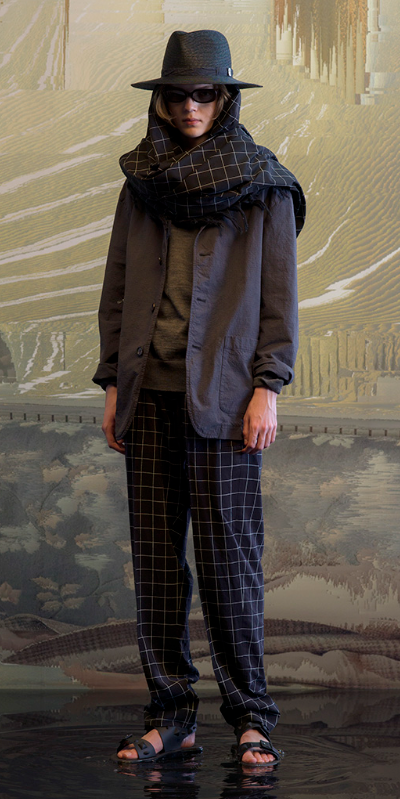 80% match
Punk and subculture spin on deconstructed Tokyo tailoring
What changes: Graphic/narrative driven rather than fabric-engineering driven
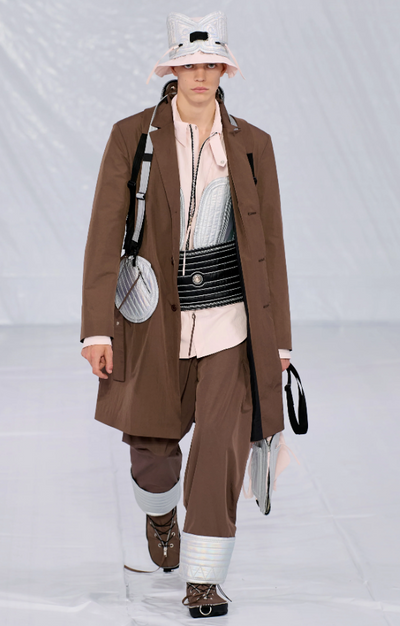 78% match
Sculptural strapped workwear, more monastic and abstract
What changes: Less denim/Americana, no big heritage collaborations
Junya Watanabe runs small. Most shoppers size up one from their usual US/EU size, but check the specific piece since deconstructed or workwear-derived items can already be cut oversized. Sized on a Japanese scale, Junya Watanabe MAN typically wears about one size smaller than comparable Western labels, so a US medium usually lands in a large, with the caveat that certain conceptual or collaboration pieces are cut intentionally voluminous.
Sized on a Japanese scale, Junya Watanabe MAN typically wears about one size smaller than comparable Western labels, so a US medium usually lands in a large, with the caveat that certain conceptual or collaboration pieces are cut intentionally voluminous. Overall shape: generally trim and narrow through the shoulders and chest on tailoring and shirting, with occasional intentionally oversized or patchwork/workwear pieces that read much fuller.
Junya Watanabe hoodies & sweatshirts fits slightly small. Take one size up if you plan to layer underneath. Shape: regular to slightly boxy depending on collaboration.
Junya Watanabe shirts & overshirts runs small. Size up one, especially if you have a broader chest or longer arms. Shape: trim through the shoulders and armhole, with narrow sleeves.
Junya Watanabe trousers & pants runs small. Expect to go up a size in the waist and to check the inseam before committing. Shape: slim to regular with a clean, tailored line.
Junya Watanabe designs under the Comme des Garcons umbrella, which administers and produces his collections from Tokyo while he shows womenswear and Junya Watanabe MAN in Paris. A Rei Kawakubo protege, he joined CDG as a pattern cutter in 1984, led the Tricot line from 1987, and launched his own label in 1992. His work centers on technical fabrics, engineered pleating, patchwork and deconstructed tailoring; menswear reworks workwear, military and denim through collaborations with The North Face, Carhartt, New Balance and Canada Goose.